
10 Critical Thinking Shortcomings That Hold Smart Teams Back
Sep 02, 2026
Why “think more critically” is too vague—and how leaders can identify where the thinking process is actually breaking down.
Leaders see the symptoms every day. An employee overlooks a key stakeholder. A team produces forty slides but never makes the takeaway clear. A capable manager brings a problem to her supervisor without proposing a solution. A group keeps defending a plan after the assumptions beneath it have changed.
We often collapse all of these behaviors into one diagnosis: they need to think more critically. But critical thinking is not one skill. It is a sequence of capabilities, and people can be strong in one part of that sequence while struggling badly in another.
That distinction matters. Generic encouragement rarely changes behavior. A precise diagnosis gives leaders something they can coach, practice, and improve. The 10 shortcomings below provide a practical vocabulary for identifying where workplace thinking is breaking down.
The 10 Shortcomings at a Glance
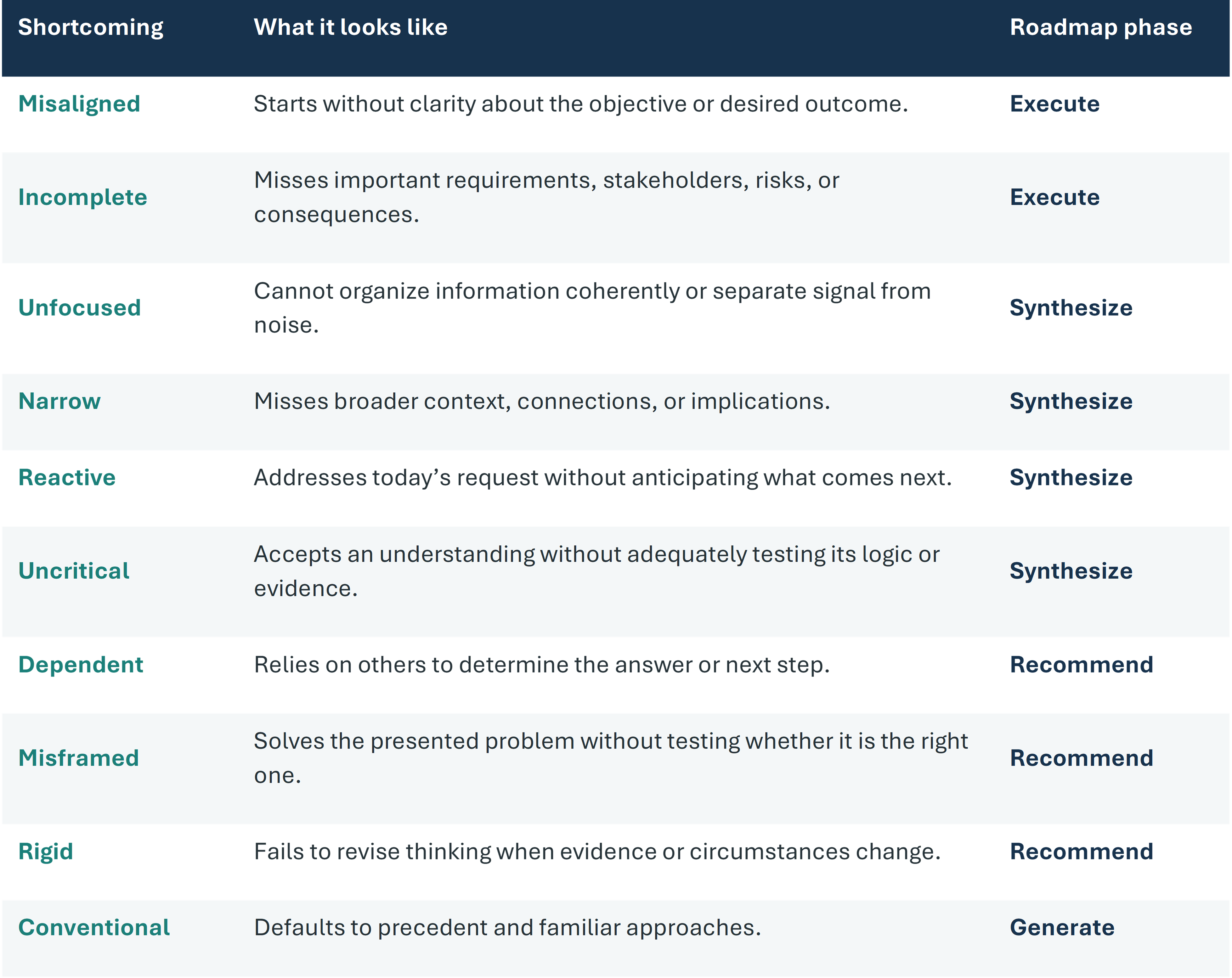
First: Can people execute against the right target?
The first breakdowns happen before analysis becomes sophisticated. People cannot deliver a robust answer if they do not understand the purpose of the work.
1. Misaligned Thinking
The work answers the request—but misses the result. People begin before they are clear about the objective, desired outcome, or definition of success. They may complete exactly what was asked and still produce something that is not useful because they never understood why the work mattered.
What it costs: Wasted effort, rework, and technically correct outputs that fail to create value.
Capability to build: Clarify the Why, What, and How—and rearticulate the intended outcome—before beginning.
2. Incomplete Thinking
Important things fall through the cracks. People overlook requirements, stakeholders, risks, dependencies, or consequences. This is different from being unfocused: the problem is not that they considered too much and chose poorly; it is that they never considered something essential at all.
What it costs: Errors, surprises, preventable risks, and manager time spent identifying omissions.
Capability to build: Use systematic completion processes and explicit checks for comprehensiveness.
Next: Can people identify what actually matters?
Once employees can understand and complete an assignment, they still have to turn information into a structured, defensible understanding. This is where teams get lost in details, treat every fact as equally important, fail to connect an immediate finding to the larger system, or accept a conclusion without adequately vetting its logic and evidence.
3. Unfocused Thinking
The information is there, but it never becomes a coherent understanding. People struggle to organize scattered information and distinguish the few insights with the greatest explanatory power or actionability. Their work may be thorough yet still leave the audience to determine how the pieces fit together and what matters most.
What it costs: Bloated deliverables, fragmented analysis, long meetings, slow decisions, and leaders forced to find the signal themselves.
Capability to build: Structure information into a coherent model, then identify important insights, exclude the unimportant, and prioritize what remains.
4. Narrow Thinking
The immediate question eclipses the bigger picture. People see the task directly in front of them but not how it connects to other teams, customers, priorities, systems, or downstream consequences. They may optimize one part of the organization while making another part worse.
What it costs: Unintended consequences, local optimization, and missed strategic insight.
Capability to build: Ask what each insight implies beyond the immediate task: “If this is true, what else does it mean?”
5. Reactive Thinking
The team completes today’s work but does not anticipate tomorrow’s. People respond to what was explicitly requested without identifying the logical next question, problem, decision, or opportunity. The manager repeatedly has to initiate the next step.
What it costs: Slower momentum, recurring manager intervention, and missed opportunities to act early.
Capability to build: Convert findings into implications and end updates with a recommendation about what should happen next.
6. Uncritical Thinking
A plausible understanding becomes the answer too quickly. People do not sufficiently test whether their evidence supports their assertions and whether those assertions support their conclusion. They overlook source limitations, contrary evidence, alternative explanations, contextual differences, or exceptions that could materially change what the situation means.
What it costs: Confident but flawed conclusions, hidden risks, and avoidable blind spots that contaminate later decisions.
Capability to build: Build the logic downward from conclusion to assertions and evidence, then test it upward: assess source quality, seek contrary evidence, examine alternative explanations, and ask whether the same evidence could support a different conclusion.
Then: Can people determine and defend what should be done?
A team can understand the assignment and develop a defensible understanding—and still struggle to turn that understanding into sound action. Recommendation-making requires people to frame the right problem, propose a path independently, defend it, and update it when reality changes.
7. Dependent Thinking
Managers are doing too much of the team’s thinking. Employees surface questions and problems but rely on someone above them to determine the answer. They may be responsible and diligent, yet stop just before the moment that requires judgment.
What it costs: Manager bottlenecks, slower decisions, reduced ownership, and limited employee growth.
Capability to build: Require questions and updates to come with a proposed recommendation and supporting rationale.
8. Misframed Thinking
The team solves the problem before deciding which problem deserves solving. People accept the initial problem statement as given. They address a symptom, reproduce the assumptions embedded in the request, or optimize an activity without defining the underlying problem and desired outcome.
What it costs: Excellent execution against the wrong problem.
Capability to build: Separate the assignment from the problem; define the desired end state; then test for root causes.
9. Rigid Thinking
People form conclusions more readily than they revise them. Once an idea, plan, or explanation takes hold, people become anchored to it. New evidence is fitted into the existing story rather than used to reconsider the story itself.
What it costs: Outdated plans, escalation of commitment, and slow adaptation when conditions change.
Capability to build: Identify the assumptions supporting a conclusion and define in advance what evidence would trigger reconsideration.
Finally: Can people get beyond the obvious answer?
Even a well-reasoned recommendation may only improve what already exists. Organizations also need people who can generate approaches that do not follow naturally from current work, current examples, or accepted constraints.
10. Conventional Thinking
New problems keep receiving old answers. People default to precedent, familiar benchmarks, and the approaches already visible inside their organization or industry. That can produce incremental improvement, but rarely a genuinely different path.
What it costs: Stagnation, missed innovation, and vulnerability when familiar approaches stop working.
Capability to build: Challenge assumed constraints, seek analogies in unfamiliar fields, and deliberately generate at least one meaningfully different option.
Do not treat the labels as personality types
These shortcomings are not fixed traits, and they are not mutually exclusive. The same person may demonstrate focused thinking in one domain and become narrow or dependent when working in an unfamiliar one. A team may also show several gaps that reinforce each other.
For example, an unfocused and dependent employee may bring a manager pages of information and expect the manager to extract the takeaway and decide what to do. A misaligned and incomplete team may execute rapidly, only to discover that it omitted essential work in pursuit of the wrong outcome. The value of the taxonomy is not the label itself; it is the more precise coaching conversation the label enables.
A practical roadmap for building better thinking
The ten shortcomings map to four developmental phases in Zarvana’s Critical Thinking Roadmap:
- Execute: Understand what is required and translate it into complete, high-quality action.
- Synthesize: Structure information, identify what matters, recognize implications, and vet the logic and evidence supporting the resulting understanding.
- Recommend: Define the problem, propose a sensible path, test the reasoning, consider alternatives and downsides, and adapt when the facts change.
- Generate: Produce valuable thinking that opens paths not already implied by existing work.
This sequence also gives leaders a better development strategy. Do not ask someone to produce breakthrough ideas if they cannot yet identify the important facts. Do not ask for more independence without teaching a repeatable way to frame, construct, and test recommendations. And do not assume that a smart employee will discover these processes alone.
Better thinking starts with a better diagnosis. Instead of telling employees to “think more critically,” identify where the process breaks down—and teach the repeatable capability that replaces it.